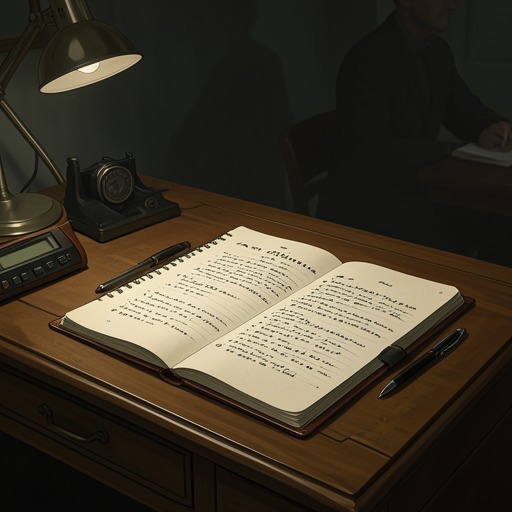
Soms weten we niet wat ons verhaal is totdat we het onszelf vertellen
Mr. & Mrs. Smith"Sometimes we don’t know what our story is until we tell it to ourselves" is Dr. Wexler’s rationale for asking the Smiths to write privately about their feelings. The expression links self-understanding to narration: the act of telling a story, even only to oneself, can make an obscured problem legible. By the novel’s conclusion, the principle has become both the logic of the therapy sessions and a frame for the couple’s renewed beginning.
The expression in the therapy sessions
Dr. Wexler introduces the idea while giving Jane Smith a writing assignment. He asks her to put her feelings on paper, emphasizing that it is not a school exercise, need not look impressive or consist of complete sentences, and does not have to be shown to him or anyone else. Its purpose is insight: writing may help her understand what is really bothering her. The expression names that purpose without demanding a polished confession or an audience.
When Jane asks how to begin, Dr. Wexler directs her to start at the beginning and write about how she and John Smith met and why she first fell in love with him. Her response moves from hesitation toward a remembered pleasure: she smiles and recalls Bogotá, six years earlier. The assignment thus turns an indistinct present difficulty toward the couple’s shared past, giving memory a place in the work of understanding.
A shared invitation, not a demand for disclosure
Dr. Wexler later repeats the principle to John Smith, who wants to know whether Jane will have to see what he writes. The doctor tells him that she need not see it, and neither does he; sharing is optional. The point is to let John write freely enough to discover what is troubling him. This repetition makes the expression apply to both spouses, while preserving the privacy of each person’s account.
That privacy matters to the scene’s form as well as its advice. The sessions are recorded, summarized, and typed by Dr. Wexler’s assistant, Katrina Östlicher, with notes on the patients’ expressions and body language. Yet the writing assignment itself is explicitly for the writer alone unless they choose otherwise. The contrast distinguishes the therapist’s documented case record from the Smiths’ private attempt to find words for their own experience.
From self-narration to a new beginning
At the close, Dr. Wexler calls the Smiths a successful case and specifically credits putting feelings on paper. He has not seen them for some time when a change-of-address notice arrives, written in Jane’s hand and signed by Jane and John. He sends a fruit basket to congratulate them on their new home and reminds them that they still have a session owed. Their note and move do not provide the contents of their private writing, but they offer a concrete aftermath to the therapeutic process.
The novel also echoes the expression in its description of the couple after their reconciliation: it is a new day, and they have the privilege of beginning again. In this closing movement, telling oneself a story is not presented as a guarantee that the past disappears. Rather, the phrase connects the work of understanding what has gone wrong with the possibility of seeing a shared life differently and choosing to start anew.